















In brief: A 2024 meta-analysis of 316 participants found CBD produced a large, statistically significant reduction in anxiety symptoms (Hedges’ g = −0.92), as published in Psychiatry Research (Han et al., 2024). This finding was independently confirmed in the largest clinical review ever conducted, where a subgroup analysis of pure CBD yielded a moderate, significant effect (Wilson et al., The Lancet Psychiatry, 2026) — and the biological mechanism behind this, involving a serotonin receptor most people have never heard of, is what makes the finding particularly interesting.
In March 2026, The Lancet Psychiatry published the largest clinical review of cannabinoids for mental health ever conducted — 54 randomised controlled trials, 2,477 participants, 45 years of data (Wilson et al., 2026). Headlines declared that cannabis doesn’t work for anxiety. What most reports didn’t mention: when researchers isolated pure cannabidiol from the broader group of cannabinoids, the anxiolytic effect remained statistically significant.
That distinction matters. It reflects something the research has been signalling for over a decade: CBD and anxiety is not a fringe topic — it is one of the most actively reviewed areas in cannabinoid science. Between 2024 and 2026 alone, at least four independent systematic reviews and meta-analyses examined this question, each drawing on an expanding pool of clinical trials. The field has matured from early preclinical signals to Phase 3 randomised controlled trials with hundreds of participants. This article reflects the research and regulatory landscape available as of March 2026.
What this article covers:
- A 2024 meta-analysis found CBD produced a large, statistically significant reduction in anxiety symptoms across multiple anxiety disorders (Han et al., Psychiatry Research)
- Even the largest RCT-only analysis ever conducted — 54 trials, 2,477 participants — confirmed a moderate, significant anxiolytic effect for pure CBD compounds (Wilson et al., The Lancet Psychiatry, 2026)
- CBD’s anxiolytic mechanism operates through the 5-HT1A serotonin receptor — a fundamentally different pathway from conventional anti-anxiety medications
- A Phase 3 double-blind trial with 178 participants produced results that address the main criticism levelled at earlier CBD-anxiety studies — and the outcome changes the conversation about what constitutes strong evidence in this field
- After reading, you’ll be able to evaluate the strength of the evidence for CBD and anxiety, understand the biological mechanism, and assess where the research is headed
What Does the Latest Meta-Analytic Evidence Show?
The answer box above summarised the headline numbers. Now let’s look at how researchers arrived at them — and why the convergence across multiple independent analyses is what makes this evidence base genuinely compelling.
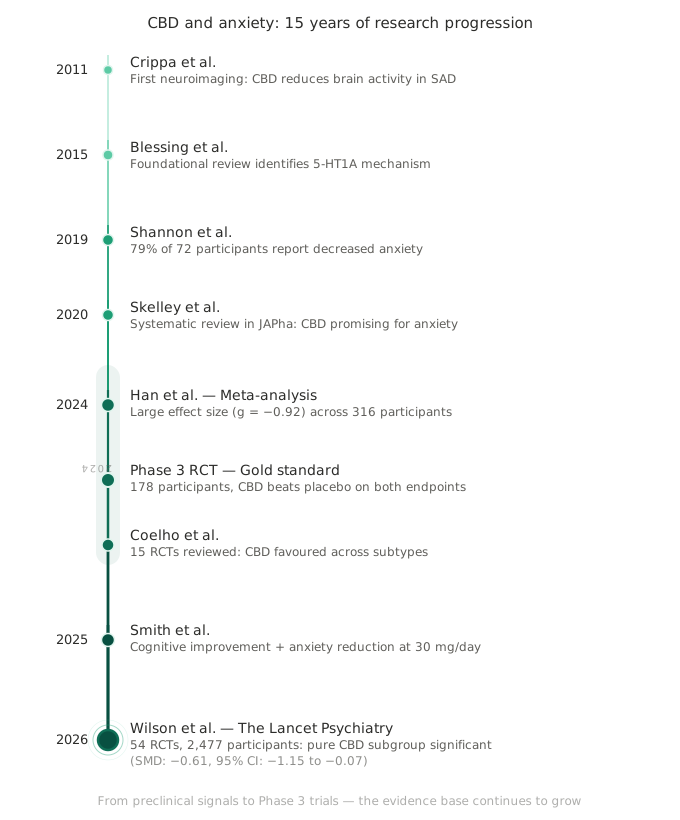
Meta-analyses pool the results of multiple clinical trials to identify patterns that individual studies, each with their own sample sizes and designs, cannot reveal alone. For CBD and anxiety, the first large-scale attempt came in 2024, when a team led by Han and colleagues screened 1,550 articles and identified eight clinical studies meeting their inclusion criteria. The resulting analysis, published in Psychiatry Research, covered 316 participants across generalised anxiety disorder, social anxiety disorder, and PTSD (Han et al., 2024).
The effect size was striking. Hedges’ g came in at −0.92 — a value that falls in the “large” range by conventional standards. To put that in perspective, many widely prescribed psychiatric medications produce effect sizes between 0.3 and 0.5. CBD, across these eight studies, exceeded that threshold considerably.
But a single meta-analysis, no matter how well conducted, is one data point. The question is whether the finding holds up when other teams, using different methods and larger datasets, ask the same question.
It does. In 2026, Wilson and colleagues published the most comprehensive RCT-only review of cannabinoids for mental health ever conducted — 54 randomised controlled trials spanning 45 years and covering 2,477 participants — in The Lancet Psychiatry (Wilson et al., 2026). When the analysis grouped all cannabinoids together, the anxiolytic signal did not reach significance. But when the researchers isolated pure CBD compounds, a moderate, statistically significant effect emerged (SMD: −0.61, 95% CI: −1.15 to −0.07). That distinction — between cannabinoids broadly and CBD specifically — is precisely the kind of nuance that meta-analyses are designed to detect.
Here’s why this matters if you’re evaluating the evidence for yourself.
When two independent research teams, using different databases, different inclusion criteria, and different statistical approaches, arrive at the same directional conclusion — CBD produces a statistically significant reduction in anxiety symptoms — that is not a coincidence. It is convergence. And convergence is what moves a finding from “interesting” to “robust.”
Which Anxiety Disorders Have the Strongest Evidence?
Not all anxiety disorders have been studied equally. Social anxiety disorder (SAD) has the deepest evidence base, with multiple studies — including neuroimaging research by Crippa and colleagues — demonstrating measurable changes in brain activity alongside behavioural improvements after CBD administration (Crippa et al., 2011). Generalised anxiety disorder (GAD) is close behind, bolstered by the 2024 Phase 3 trial discussed below. PTSD evidence is emerging but more limited, with smaller sample sizes and fewer completed RCTs.
A separate 2024 systematic review of RCTs published in Life (MDPI) examined 15 randomised controlled trials covering CBD doses from 13.75 mg to 800 mg (Coelho et al., 2024). Despite wide variation in protocols, the overall direction favoured CBD over placebo, with a favourable safety profile across anxiety subtypes.
Key takeaway: Multiple independent meta-analyses and systematic reviews, published between 2024 and 2026 and covering thousands of participants, consistently identify a statistically significant anxiolytic effect for CBD — a finding that held up even under the most demanding analytical conditions applied to date.
How Does CBD Affect Anxiety at the Biological Level?
Statistical significance is one thing. Understanding why CBD produces these effects is another — and it is the mechanistic evidence that gives the clinical findings their scientific weight.
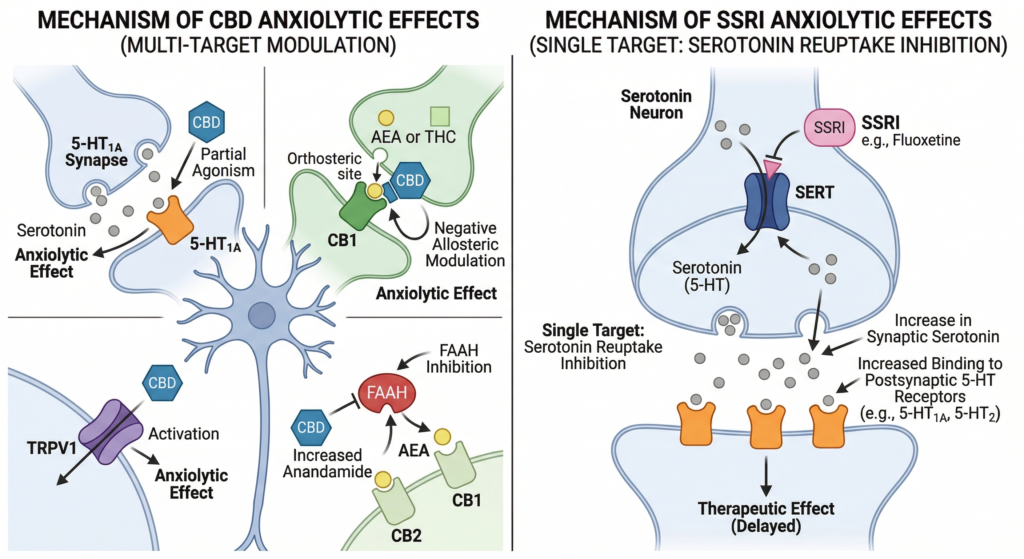
The broad picture: CBD interacts with multiple molecular targets in the central nervous system. Unlike THC, it does not bind directly to CB1 cannabinoid receptors and produces no intoxicating effect. Instead, its anxiolytic action appears to operate through a different system entirely — one that conventional anti-anxiety medications also target, but through a different door.
The specific mechanism centres on the 5-HT1A serotonin receptor. CBD acts as a partial agonist at this receptor, meaning it activates it at a moderate level without fully saturating the system. This is the same receptor targeted by buspirone, a prescribed anxiolytic, and it is functionally connected to the serotonin pathways that SSRIs modulate indirectly. A foundational review published in Neurotherapeutics laid out this mechanism in detail, noting that CBD’s anxiolytic effects in preclinical models were blocked when the 5-HT1A receptor was chemically inhibited — strong evidence that this receptor is central to the process (Blessing et al., 2015).
That single finding changed how researchers understood CBD’s pharmacology.
But 5-HT1A is not the only player. CBD also acts as a negative allosteric modulator of CB1 receptors — it doesn’t block them outright, but it changes how they respond to other signals. Coelho and colleagues noted that this modulation may help counteract the anxiety-promoting effects that can occur when CB1 receptors are overstimulated, as sometimes happens with THC (Coelho et al., 2024). Additionally, CBD interacts with TRPV1 receptors, which are involved in pain perception and emotional regulation, and it inhibits the enzyme FAAH (fatty acid amide hydrolase), which breaks down anandamide — the body’s own endocannabinoid sometimes called the “bliss molecule.”
So what does this multi-target profile actually mean for someone reading about CBD for the first time?
It means CBD doesn’t work like a sledgehammer — it works more like a thermostat. Rather than flooding a single receptor system, it appears to modulate several interconnected pathways simultaneously. This is part of what makes it attractive to researchers: the mechanism suggests a regulatory, balancing effect rather than a brute-force pharmacological one. And it explains why, in clinical studies, CBD’s side effect profile has been consistently mild — fatigue and sedation are the most commonly reported effects, with no evidence of dependence or withdrawal (Skelley et al., 2020).
Why it matters: CBD’s anxiolytic effect is not a mystery — it operates through well-characterised receptor systems, particularly the 5-HT1A serotonin receptor, and its multi-target profile may explain both its efficacy and its favourable tolerability in clinical studies.
What Did Clinical Trials Find in Human Participants?
The mechanistic picture is elegant. But mechanisms demonstrated in cell cultures and animal models do not automatically translate to human outcomes. So what happens when researchers test CBD in people with clinically significant anxiety?
The honest answer is that the clinical evidence is messy — and that’s actually normal for a field at this stage of development. Doses across published studies range from 6 mg to 800 mg. Some trials administer a single dose before a stressful task; others follow participants for weeks. Study designs span open-label pilots to fully blinded Phase 3 trials. A systematic review published in the Journal of the American Pharmacists Association identified eight eligible studies — six small RCTs, one case series, and one case report — and noted that dosing strategies and outcome measures varied widely (Skelley et al., 2020).
This heterogeneity makes clean comparisons difficult. It also reflects a research field that is still determining optimal protocols — a characteristic shared by virtually every compound in the early-to-middle stages of clinical investigation.
And yet, when you look at the individual studies, a pattern emerges.
One of the most cited early studies followed 72 adults over 12 weeks. Published in The Permanente Journal, the trial found that 79% of participants reported decreased anxiety scores within the first month of CBD use, and these improvements were sustained throughout the study period (Shannon et al., 2019). The design was open-label — no placebo control — which limits the conclusions that can be drawn. But the consistency and speed of the response across a clinical population drew significant research attention.
Stronger evidence arrived in 2024 with a Phase 3, double-blind, placebo-controlled RCT — the gold standard of clinical trial design. Conducted across multiple sites with 178 participants randomised to CBD or placebo, this study tested a nanodispersible CBD oral solution over 15 weeks in adults with mild-to-moderate anxiety disorders. The results, published in Psychiatry Research, were unambiguous: CBD significantly outperformed placebo on both primary endpoints — the GAD-7 score (difference: −7.02, p<0.0001) and the Hamilton Anxiety Rating Scale (difference: −11.9, p<0.0001). Secondary outcomes, including depression and sleep quality, also improved.
This is the study that changes the conversation.
It addresses, in a single trial, the three most common criticisms of earlier CBD-anxiety research: small sample size, short duration, and lack of rigorous placebo controls. With 178 participants, 15 weeks of treatment, and a fully blinded design, it meets the evidentiary bar that sceptics have been asking for. And the effect sizes were not marginal — they were highly statistically significant on both primary measures.
More recently, a 2025 open-label pilot published in Biomedicines added a novel dimension. Twelve patients with moderate-to-severe anxiety received a full-spectrum, high-CBD sublingual solution (30 mg/day) for six weeks. Beyond the expected anxiety reduction, researchers observed significant improvements in executive function — faster response times and higher accuracy on cognitive tasks (Smith et al., 2025). This is the first clinical study to demonstrate cognitive improvement alongside anxiety reduction with a commercially relevant CBD product and dose, a finding with potentially important implications for how CBD interacts with cognitive systems under stress.

| Study | Year | Design | Participants | Condition | Key Finding |
|---|---|---|---|---|---|
| Shannon et al. | 2019 | Open-label, 12 weeks | 72 | Anxiety + sleep | 79% reported decreased anxiety scores within first month |
| Han et al. | 2024 | Meta-analysis of 8 RCTs | 316 | GAD, SAD, PTSD | Large effect size (Hedges’ g = −0.92, p < 0.05) |
| Phase 3 RCT (India) | 2024 | Double-blind RCT, 15 weeks | 178 | Mild-to-moderate anxiety | CBD significantly outperformed placebo on GAD-7 (p<0.0001) and HAM-A (p<0.0001) |
| Coelho et al. | 2024 | Systematic review of 15 RCTs | — | Multiple anxiety disorders | CBD favoured over placebo across subtypes; minimal adverse effects |
| Wilson et al. (CBD subgroup) | 2026 | Meta-analysis of 54 RCTs | 2,477 | All anxiety disorders | Pure CBD: moderate, significant effect (SMD: −0.61) |
| Smith et al. | 2025 | Open-label pilot, 6 weeks | 12 | Moderate-to-severe anxiety | Significant anxiety reduction + improved executive function with 30 mg/day full-spectrum CBD |
The bottom line: Despite wide variation in dosing protocols and study designs, the direction of clinical evidence for CBD and anxiety is consistently positive — and the strongest individual trial to date, a Phase 3 RCT with 178 participants, produced highly significant results on both primary endpoints.
How Does CBD Compare to Conventional Anxiety Treatments?
Understanding what clinical trials found is one thing. Understanding what those findings mean in the context of existing treatment options is what most readers actually want to know.
The current first-line pharmacological treatments for anxiety disorders include selective serotonin reuptake inhibitors (SSRIs), serotonin-norepinephrine reuptake inhibitors (SNRIs), and benzodiazepines. These medications are well-established and widely prescribed — but they come with well-documented limitations. A comprehensive review published in Neurotherapeutics noted that current anxiolytic medications achieve full remission in only 40–60% of patients, with a significant proportion experiencing residual symptoms even after treatment (Blessing et al., 2015). Benzodiazepines, while fast-acting, carry established risks of tolerance, dependence, and withdrawal. SSRIs typically require 4–6 weeks to reach full effect and are associated with side effects including sexual dysfunction, weight gain, and emotional blunting.
This is the clinical context that has driven research interest in CBD. It is not that conventional treatments don’t work — they do, for many people. It is that a substantial minority of patients either don’t respond, can’t tolerate the side effects, or are looking for options with a different risk profile. Researchers have noted that CBD’s mechanism — 5-HT1A partial agonism — engages the same serotonergic system as SSRIs, but through a fundamentally different approach: modulation rather than reuptake inhibition (Coelho et al., 2024).
What does that difference look like in practice?
| Feature | SSRIs / SNRIs | Benzodiazepines | CBD (research findings) |
|---|---|---|---|
| Primary mechanism | Serotonin reuptake inhibition | GABA-A receptor potentiation | 5-HT1A partial agonism + CB1 modulation |
| Time to effect | 4–6 weeks | Minutes to hours | Acute effects observed in single-dose studies; sustained effects in multi-week trials |
| Dependence risk | Discontinuation syndrome possible | Established dependence and withdrawal risk | No evidence of dependence or withdrawal in clinical studies |
| Common side effects | Sexual dysfunction, weight gain, emotional blunting, nausea | Sedation, cognitive impairment, rebound anxiety | Fatigue, sedation (mild); no psychomotor or cognitive impairment observed |
| Remission rate | 40–60% (Blessing et al., 2015) | Effective short-term; not recommended for long-term use | Not yet established at population level; individual trial outcomes highly positive |
This comparison is not an argument that CBD should replace prescribed medication. It is the factual context that explains why researchers — and an increasing number of people exploring their options — find CBD’s profile worth investigating. As with any wellness decision, consulting a healthcare provider is recommended, particularly for those on existing medication.
For readers who want to explore the growing body of CBD research alongside high-quality products, full spectrum CBD oils from Pure CBD offer formulations consistent with the types of products used in several of the studies discussed above.
What this means in practice: CBD operates through a different biological pathway than conventional anxiolytics, produces minimal side effects in clinical studies, and shows no evidence of dependence — a combination that has made it one of the most actively investigated alternative approaches to anxiety in current pharmacological research.
What Are the Current Limitations of CBD-Anxiety Research?
The evidence presented above is genuinely promising. It is also incomplete — and acknowledging what remains unknown is part of taking the science seriously.
The most significant limitation is total sample size. The largest individual RCT to date included 178 participants — a respectable number for a Phase 3 trial, but far below the thousands enrolled in landmark studies of SSRIs. Meta-analyses partially compensate for this by pooling data, but the underlying studies remain mostly small. This is not unusual for a research field at this stage of development — early SSRI trials in the 1980s involved similar sample sizes — but it means the evidence should be read as strong and directional rather than definitive.
Dosage standardisation remains an open question. Clinical studies have used doses ranging from 6 mg to 800 mg, administered as single doses, daily regimens, or split doses. The 2024 Phase 3 trial used a nanodispersible formulation to improve bioavailability; the 2025 Smith pilot used 30 mg/day of a full-spectrum sublingual product. These are very different approaches producing positive results, which raises the question of whether the optimal dose depends on the formulation, the condition, or both. Larger dose-response studies are needed to answer this.
Long-term data is growing but still limited. The longest published RCT ran for 15 weeks. Studies tracking participants for 6–12 months or longer would strengthen the evidence for sustained use, and several such trials are now in progress.
These are the normal growing pains of a rapidly maturing field. The research trajectory is clear: studies are getting larger, longer, and more methodologically rigorous with each passing year. The fact that CBD’s anxiolytic signal has remained significant across this progression — from small open-label pilots to a 54-trial meta-analysis — is itself a meaningful finding. Individual responses to CBD vary, as they do with most bioactive compounds.
For those interested in exploring CBD products while the research continues to mature, explore Pure CBD’s product range for options aligned with the types of formulations studied in clinical settings.
The essential point: The limitations of current CBD-anxiety research — modest sample sizes, variable dosing, limited long-term data — are characteristic of a field in active development, not evidence of a fundamental problem with the compound itself, and each of these gaps is being actively addressed by ongoing clinical trials.
Regulatory note: No CBD product has been authorised in the European Union for the management of anxiety. Consumer CBD products intended for oral use remain classified as Novel Foods under EU Regulation 2015/2283, and no Novel Food authorisation has been granted to date. In February 2026, EFSA established a provisional safe daily intake of approximately 2 mg for a 70 kg adult — substantially below the doses used in the clinical studies reviewed in this article. EFSA’s updated safety assessment of cannabidiol highlights persistent data gaps and excludes individuals under 25, pregnant or lactating women, and those on medication from established safety conclusions. For a complete overview of CBD’s legal and regulatory status across EU member states, see our dedicated guide: CBD Regulation in Europe: Current Status and What You Need to Know.
Frequently Asked Questions
Important: This article is for informational purposes only and does not constitute medical advice. CBD products are not medicines and are not intended to diagnose, treat, cure, or prevent any disease. Consult a healthcare professional before making decisions about your health. Regulations regarding CBD products vary across EU member states — read our complete guide to CBD regulation in Europe and verify the legal status in your country before purchasing.
Sources and Further Reading
- Han K, Wang J-Y, Wang P-Y, Peng Y-C-H. Therapeutic potential of cannabidiol (CBD) in anxiety disorders: A systematic review and meta-analysis. Psychiatry Research, 2024; 339: 116049.
- Wilson J, Dobson O, Langcake A, et al. The efficacy and safety of cannabinoids for the treatment of mental disorders and substance use disorders: a systematic review and meta-analysis. The Lancet Psychiatry, 2026; 13(4): 304–315.
- Coelho C de F, Vieira RP, Araújo-Junior OS, et al. The Impact of Cannabidiol Treatment on Anxiety Disorders: A Systematic Review of Randomized Controlled Clinical Trials. Life, 2024; 14(11): 1373.
- Blessing EM, Steenkamp MM, Manzanares J, Marmar CR. Cannabidiol as a Potential Treatment for Anxiety Disorders. Neurotherapeutics, 2015; 12(4): 825–836.
- Skelley JW, Deas CM, Curren Z, Ennis J. Use of cannabidiol in anxiety and anxiety-related disorders. Journal of the American Pharmacists Association, 2020; 60(1): 253–261.
- Phase 3, double-blind, placebo-controlled RCT: Evaluation of the efficacy, safety, and pharmacokinetics of nanodispersible cannabidiol oral solution versus placebo in mild to moderate anxiety subjects. Psychiatry Research, 2024.
- Smith RT, Dahlgren MK, Sagar KA, Kosereisoglu D, Gruber SA. Clinical and Cognitive Improvement Following Treatment with a Hemp-Derived, Full-Spectrum, High-Cannabidiol Product in Patients with Anxiety: An Open-Label Pilot Study. Biomedicines, 2025; 13(8): 1874.
- Shannon S, Lewis N, Lee H, Hughes S. Cannabidiol in Anxiety and Sleep: A Large Case Series. The Permanente Journal, 2019; 23: 18–041.
- Crippa JAS, Derenusson GN, Ferrari TB, et al. Neural Basis of Anxiolytic Effects of Cannabidiol (CBD) in Generalized Social Anxiety Disorder: A Preliminary Report. Journal of Psychopharmacology, 2011; 25(1): 121–130.
- Bergamaschi MM, Queiroz RHC, Chagas MHN, et al. Cannabidiol Reduces the Anxiety Induced by Simulated Public Speaking in Treatment-Naïve Social Phobia Patients. Neuropsychopharmacology, 2011; 36(6): 1219–1226.
- EFSA NDA Panel. Update of the statement on safety of cannabidiol as a novel food. EFSA Journal, 2026; 24(2): e9862.
